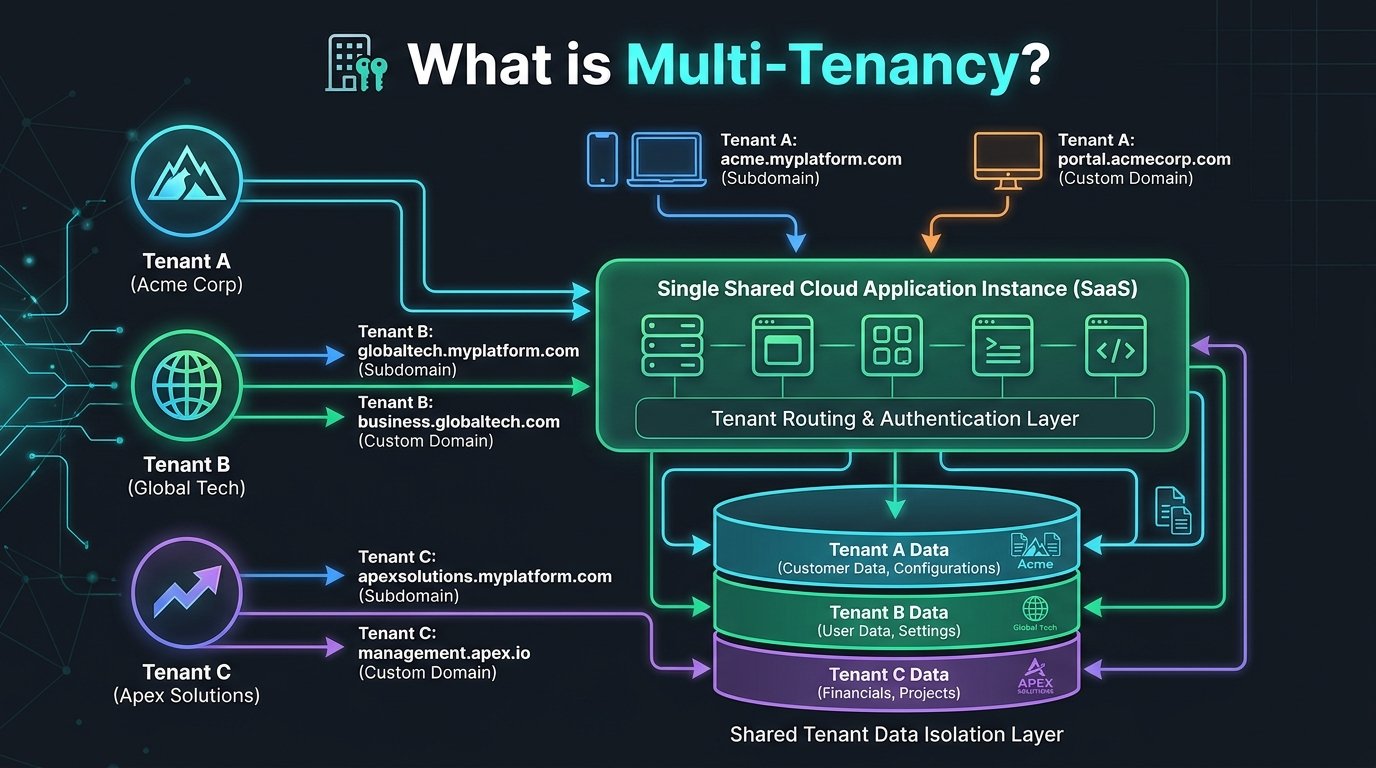
What Is Multi-Tenancy?

If you have ever used Slack, Shopify, or Jira, you have used a multi-tenant application. When your company signs up for a workspace, you get your own subdomain (yourcompany.slack.com), your own users, your own permissions, and your own private data—yet the vendor isn't spinning up a brand-new server and deploying a separate copy of their codebase just for you.
Instead, multi-tenancy is a software architecture pattern where a single instance of an application serves multiple distinct customers (called "tenants") simultaneously, while keeping each tenant’s data, configuration, and users strictly isolated from one another.
The Apartment Building Analogy
The easiest way to understand multi-tenancy is to compare Single-Tenant vs. Multi-Tenant housing:
Single-Tenant Architecture (Detached Houses): Every customer gets their own dedicated server, database, and deployed codebase. It offers maximum isolation, but maintaining 500 separate houses means fixing 500 roofs every time you release a bug fix.
Multi-Tenant Architecture (An Apartment Building): Everyone shares the same foundational infrastructure—plumbing, electricity, security, and structure (your application codebase, servers, and deployment pipeline). However, each apartment (tenant) has its own locked front door, private rooms, and custom interior setup.
The 3 Pillars of a Multi-Tenant System
To turn a standard single-company PHP/Laravel application into a true multi-tenant SaaS platform, your architecture has to solve three core problems:
1. Tenant Identification (Knowing Who Is Knocking)
Before your application runs any business logic, middleware must inspect the incoming request and resolve which tenant owns it. Common identification strategies include:
Subdomains:
tenant-a.yourapp.comvs.tenant-b.yourapp.comCustom Domains:
portal.clientdomain.commapped via CNAME recordsURL Path Prefixes:
[yourapp.com/tenant-a/dashboard](https://yourapp.com/tenant-a/dashboard)API Headers / Tokens: An
X-Tenant-IDheader or a tenant-bound Sanctum/OAuth token
Laravel Sample Code:
// Example: Resolving the active tenant early in a Laravel Middleware
class IdentifyTenant{
    public function handle(Request $request, Closure $next){
        $subdomain = explode('.', $request->getHost())[0];
        $tenant    = Tenant::where('subdomain', $subdomain)->firstOrFail();

        // Bind the resolved tenant into Laravel's Service Container
        app()->instance(Tenant::class, $tenant);

        return $next($request);
    }
}
2. Strict Data Isolation (Keeping Doors Locked)
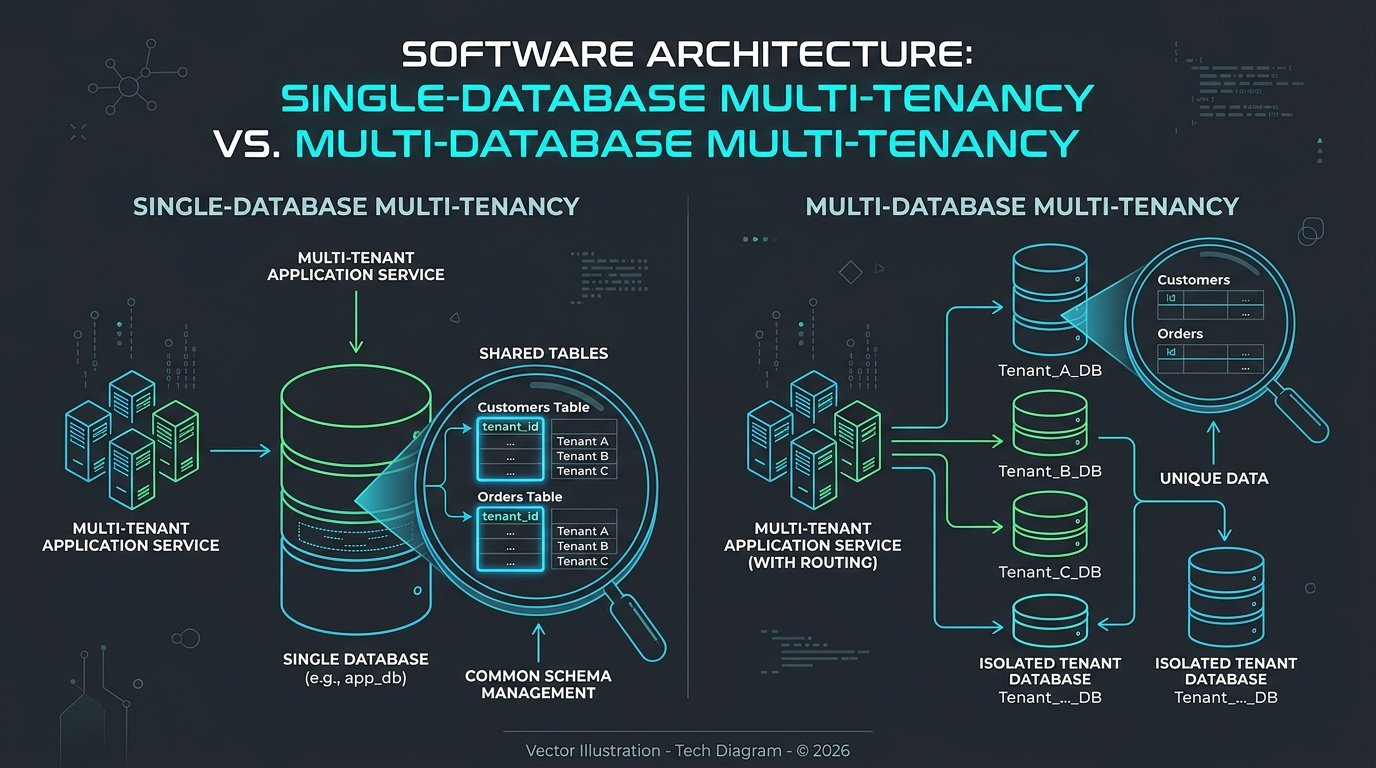
The golden rule of multi-tenancy is that Tenant A must never see, query, or mutate Tenant B’s data. Depending on compliance and scale requirements, teams enforce isolation by either tagging every row with a tenant_id column (scoped automatically via Global Scopes) or routing each tenant to its own isolated database connection.
3. Tenant-Specific Customization (Making Each Apartment Unique)
Even though all tenants run on the exact same codebase, each business expects the platform to feel like their system:
Branding: Custom logos, colors, and email sender domains.
Configuration & Billing Tiers: Feature flags enabling or disabling modules based on whether Tenant A is on the Basic plan and Tenant B is on Enterprise.
Role-Based Access Control (RBAC): A user might be an
Adminin Workspace A, while havingViewerpermissions (or no access at all) in Workspace B.
Why Businesses and Engineers Love Multi-Tenancy
Deploy Once, Update Everyone: Pushing a security patch or new feature updates all 1,000 customers in a single CI/CD run.
Dramatically Lower Infrastructure Costs: Instead of paying for hundreds of idle servers and databases, compute and memory resources are pooled efficiently across active tenants.
Faster Customer Onboarding: New customers can sign up, provision their workspace, and start working in seconds without manual DevOps intervention.
Recent Posts

.jpg)
.jpg)
.jpg)